Here are resources for families and caregivers from both within and beyond Minnesota that center on Positive Supports, Functional Behavior Assessment, and person-centered planning.
Guidelines for Positive Supports in DHS‑Licensed Settings (DHS‑6810C‑ENG)
Developing Positive Support Transition Plans – Provider Guide for 245D
CBSM – Positive Supports (Minnesota DHS)
Positive Behavior Support: Introductory Guide (University of Kansas)
Living on Purpose
Understanding the experiences we support
When a person can’t put a need into words, it can show up as behavior. We look beneath the moment to find what it’s communicating — and respond with understanding. Tap a topic to learn more.
Aggression — hitting, throwing, kicking, or lashing out — is one of the most stressful behaviors for families to navigate, and one of the most misunderstood. Behaviors like these are not signs of a person being bad or defiant. They are most often communication, a sensory response, or a way of coping with a situation that has become overwhelming.
A person may be trying to escape a demand, ask for something they can’t name, or signal that they are anxious, in pain, or over-stimulated. Because the trigger usually sits underneath the moment, lasting change comes from understanding the cause, reducing known triggers, keeping everyone safe in the moment, and patiently teaching and reinforcing calmer ways to communicate.
Helpful Links
Challenging Behaviors Tool Kit — Autism Speaks
Challenging Behaviors Roadmap for Families — Autism Speaks
Helpful Strategies to Promote Positive Behavior — Autism Speaks
Elopement — sometimes called wandering, bolting, or running — is when a person leaves a safe space without supervision. People may move toward something that interests them, or away from something that feels uncomfortable or frightening, and some elopement happens during the confusion of a transition.
It is more common than many families realize and carries real safety risks, which is why planning ahead matters so much. Prevention focuses on understanding each person’s reasons for leaving, securing the environment, teaching safety skills, and having a family emergency plan and first-responder information ready before it’s ever needed.
Helpful Links
Big Red Safety Box — free wandering-prevention toolkit — National Autism Association
Wandering-prevention resources & Elopement Alert form — AWAARE
You don’t have to navigate any of this alone. These Minnesota organizations offer support, guidance, and connection for families close to home.
Minnesota Resources
Statewide support, therapy, groups & classes — Autism Society of Minnesota (AuSM)
Free help navigating services & benefits — Disability Hub MN
Treatment of people with neurodivergent conditions including autism, ADHD, intellectual disabilities, sensory processing disorders, and other developmental and cognitive experiences, too often lacks a true understanding of neurodivergence. People are defined by diagnosis, reduced to behaviors or managed by protocols that overlook the fullness of their identities. At Stonecrest Living, we look beyond diagnoses and instead focus on root causes – trauma, neurocognitive distinctions, and behavioral health needs through loving, person-centered care that reconnects people with their often-overlooked strengths.
This is the idea at the heart of how we support people: all behavior is communication. Every behavior happens for a reason — it’s a sign that a need isn’t being met or that something doesn’t feel right, even when the person can’t say so in words.
Self-injury, aggression, elopement, and sensory dysregulation are not the problem to be stamped out; they are the visible tip of an iceberg, and the real work is understanding what sits beneath the surface — pain, fear, sensory overload, trauma, a need for connection, or a way to escape something overwhelming. Punishing a behavior may stop it for a moment, but it doesn’t address the cause or teach a better way to communicate. When we identify the root cause and respond with understanding, the behavior has less reason to continue, and the person gains skills and trust that last.
Helpful Links
Behavior Is Communication — Michigan Alliance for Families
Behavioral Resources — understanding causes & responding positively — Autism Speaks
Self-injury means any action a person uses that causes harm to their own body — for example head-banging, hitting, biting, scratching, or skin-picking. It can be frightening to witness, and many families ask the same questions: Why is this happening, and how can I help? The most important thing to understand is that a person who self-injures is almost never trying to be difficult.
When someone can’t easily put a need into words, self-injury can become a form of communication — a way of saying I’m overwhelmed, I’m in pain, I’m scared, or something needs to change. It can also meet a sensory need or be a way to escape a situation that feels like too much. Our role is to look beneath the behavior, understand what it’s communicating, and build safer ways to meet that need.
Helpful Links
Understanding & Treating Self-Injury — Autism Research Institute
Self-Injurious Behavior (CAR Autism Roadmap) — Children’s Hospital of Philadelphia
Every one of us takes in the world through our senses, but some people’s nervous systems process that input differently — and far more intensely. A person who is over-responsive may feel as though they’re being constantly bombarded by sounds, lights, textures, or movement, while another person may seek out extra sensory input to feel settled.
When the input becomes too much (or too little), the result can be sensory dysregulation: feeling overwhelmed, anxious, or unable to cope, which often shows up as distress or a change in behavior. Sensory processing can also shift from day to day depending on stress, fatigue, or the environment. Recognizing the sensory roots of a hard moment lets us adjust the environment and offer calming strategies instead of simply reacting to the behavior.
Helpful Links
What Is Sensory Processing? — STAR Institute
These links lead to outside organizations and are offered for information only. They aren’t a substitute for guidance from your care team. In an emergency, call 911.
Supporting Families
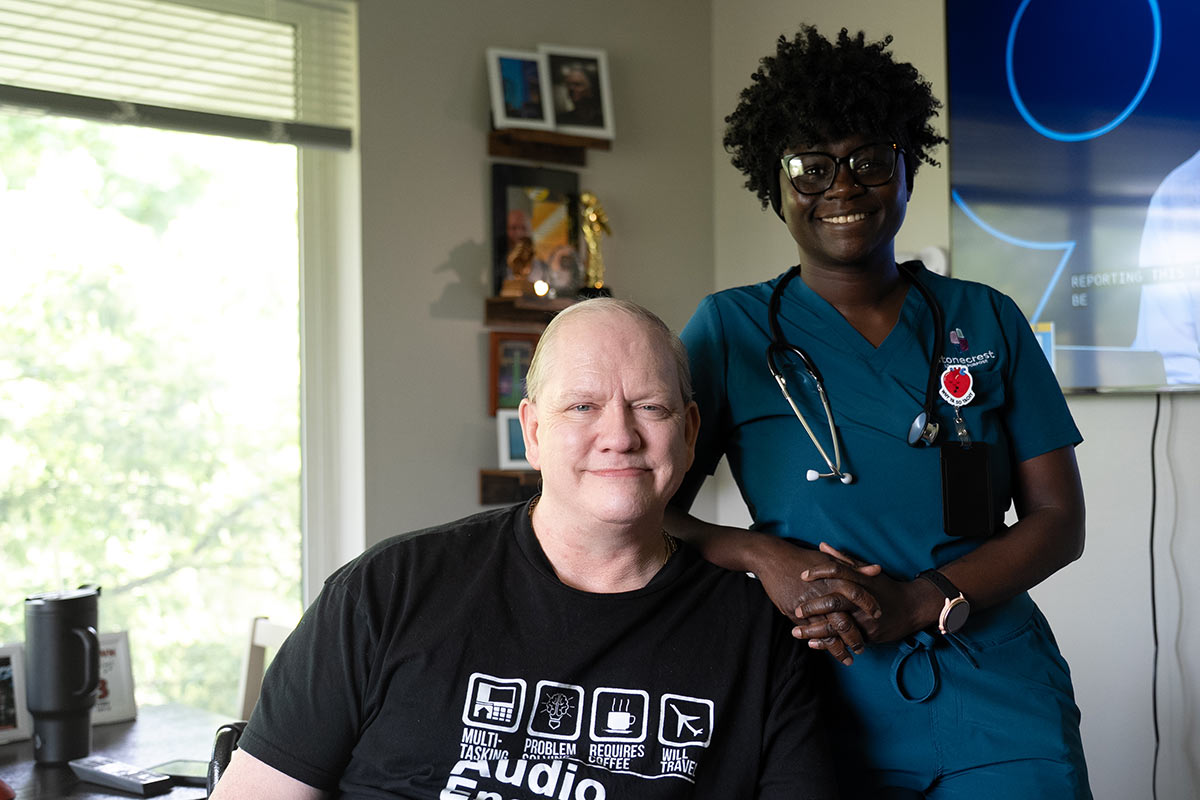
Individuals at Stonecrest Living are loved ones with complex medical needs and behavioral health conditions. They come seeking home not as a place, but an active experience where their experience and needs are honored and centered. We will always work to support these individuals and their families with tools and resources that help them experience loving, person-centered care.
24/7 Provider Line
We understand that person-centered care can only happen through person-centered communication. With our 24/7 provider line for families, individuals can always reach out to their loved one.
Family Advisory Council
In addition, any family member can join our advisory council, which meets bimonthly with training, updates, and opportunities to provide feedback on our services. This council offers a support circle for all those served by our programs and a sense of community to inform leadership of areas for growth and refinement.
Learn About Our Partners
We want to give a special thanks to all our vendors and providers who help ensure Stonecrest Living delivers dignity, respect, and culturally grounded care to individuals. Learn more about the services these organizations provide to people served and their families through the links below.
